


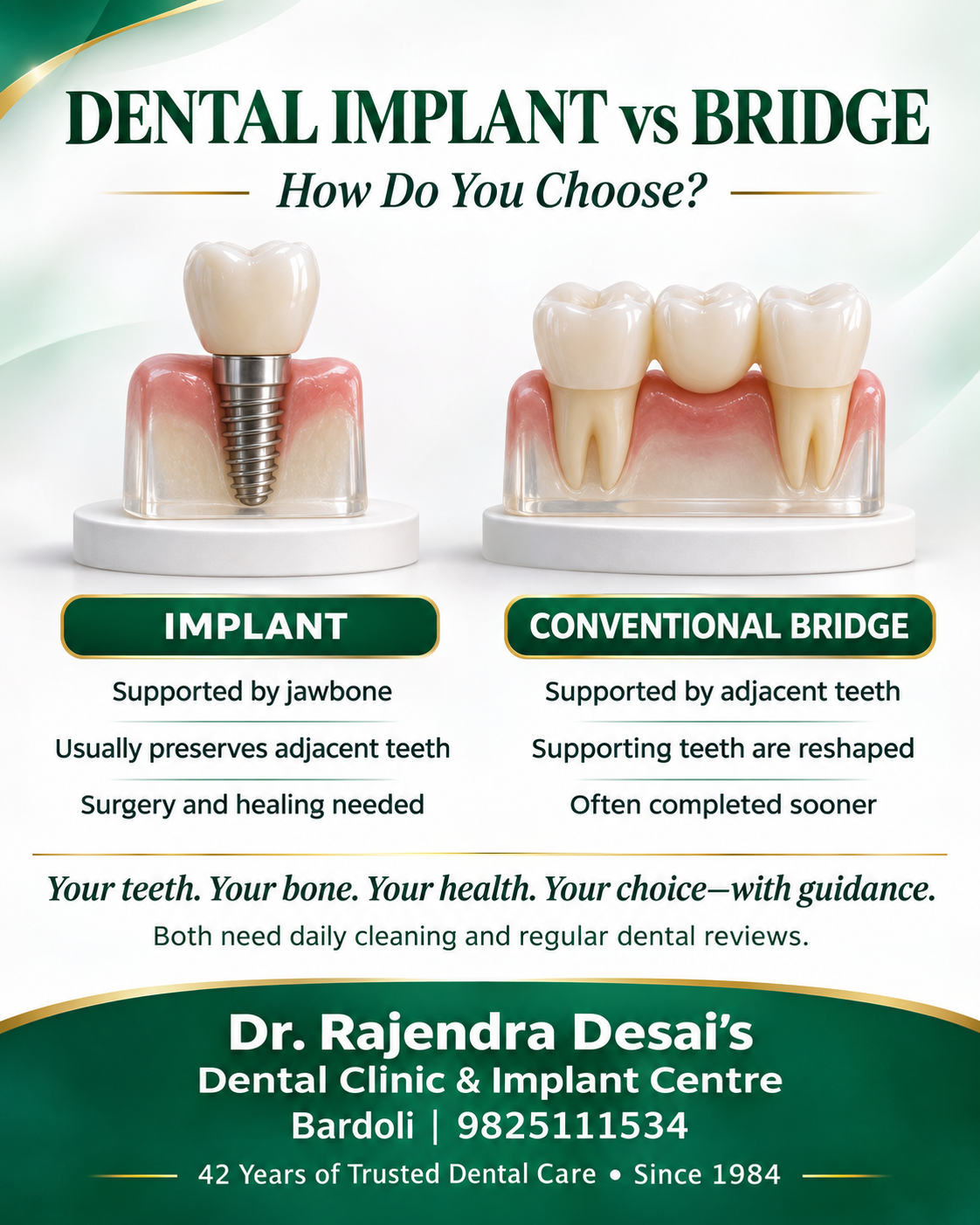
Dental Implant vs Bridge: How Do You Choose?

Dental Implant vs Bridge: How Do You Choose?
By Dr. Rajendra Desai’s Dental Clinic & Implant Centre, Bardoli
A missing tooth can affect your smile and chewing comfort. Dental implants and dental bridges are two fixed replacement options, but the right choice depends on your mouth, health, preferences, and budget.
This comparison focuses on a single implant with a crown and a conventional tooth-supported bridge. Implants can also support bridges when several teeth are missing.
What is a dental implant?
A dental implant is an artificial root placed surgically in the jawbone. After appropriate healing, it supports a replacement tooth called a crown. A single implant usually replaces a missing tooth without cutting down the neighbouring teeth.
Implants need adequate bone and healthy, well-maintained gums. Some patients need bone grafting before or alongside implant placement, which may add time and cost. Assessment includes your medical history, examination, and suitable imaging.
What is a dental bridge?
A conventional dental bridge replaces a missing tooth with an artificial tooth attached to crowns on the neighbouring teeth. These supporting teeth are reshaped to hold the bridge.
A bridge may be particularly worth considering when the neighbouring teeth already need crowns and have a good long-term outlook. In selected cases, a resin-bonded bridge can replace a tooth with little or no drilling of the supporting tooth; it is a different design from a conventional bridge.
Comparing the options
Factor
Single implant and crown
Conventional tooth-supported bridge
Support
An implant in the jawbone
Neighbouring natural teeth
Adjacent teeth
Usually avoids reshaping them
Supporting teeth need reshaping
Surgery
Required
Usually no implant surgery
Time
Healing commonly takes several months; the overall plan varies
Often completed sooner if supporting teeth are ready
Bone
Needs suitable bone; grafting may be needed
Does not replace the missing root or directly support bone at the gap
Cost
Often a higher initial cost
Often a lower initial cost; materials and complexity matter
Daily care
Clean around the implant crown and between teeth
Clean around the supporting teeth and beneath the false tooth
Five questions that help you choose
1. Are the neighbouring teeth healthy? When adjacent teeth are intact, avoiding tooth preparation may favour an implant. If they already require crowns, a bridge may make sense, provided they can support it reliably.
2. Are the gums and bone suitable? Active gum disease needs treatment and stability before either option is planned. An implant also needs enough bone in an appropriate position.
3. What does your medical history mean for healing? Smoking, diabetes control, medicines, and other health factors can affect implant planning and risk. Discuss these openly with your dentist.
4. What treatment time suits you? Implant healing can take months, especially if grafting is needed. A bridge can often be fitted sooner. Ask about temporary replacement options during treatment.
5. What can you maintain comfortably? Both options need daily cleaning and professional reviews. Ask for a demonstration of the cleaning tools and techniques you will use.
Will either option last forever?
Neither comes with a lifetime guarantee. Implants can develop inflammation and bone loss around them, fail to integrate, or develop mechanical problems. Conventional bridges can develop decay or gum problems around supporting teeth, loosen, or chip; supporting teeth may sometimes need root canal treatment. Crowns and other components may need repair or replacement over time.
Make a decision with a personalised plan
Ask your dentist to explain the likely benefits, risks, full costs, alternatives, and maintenance for your own case. A good treatment plan considers the long-term health of your whole mouth as well as the missing tooth.
Considering a replacement for a missing tooth? Book an assessment at Dr. Rajendra Desai’s Dental Clinic & Implant Centre, Bardoli. Call 9825111534.
Patient-information sources
American Academy of Periodontology: Single Tooth Dental Implants
Cambridge University Hospitals: Dental implants in restorative dentistry
University of Bristol: Conventional dental bridges — patient information
US FDA: Dental Implants: What You Should Know
General patient education. Your dentist’s examination determines which options are suitable.
Comments